

When someone asks "what is slog," the answer isn't as simple as you might think. It’s a term that lives three entirely different lives depending on who you're talking to. It could be a high-octane system for distributed databases, a handy logging package in the Go programming language, or even a metaphor for a sluggish economy.
This guide will untangle these meanings for you, making it easy to figure out which "slog" you’re actually dealing with.
Decoding the Three Meanings of Slog

"Slog" is a perfect example of a word that wears multiple hats. Without context, you could find yourself neck-deep in database architecture when all you wanted was a programming tool or some insight into economic trends. Let’s get you oriented so you know exactly which path to take.
Each definition tackles a unique problem in its own world, from keeping data in sync across the globe to making software debugging less of a headache. Think of this as your quick-start guide to the three worlds of Slog.
The Three Worlds of Slog
We're going to break down the term into its three distinct fields so you can jump straight to what’s relevant for you. Here’s what we’ll cover:
- Slog in Distributed Databases: In this world, Slog is a powerhouse system built to manage data across multiple locations. Its entire purpose is to deliver blazing-fast performance and low latency without sacrificing data consistency.
- Slog in Go Programming: For developers working with the Go language,
slogis the standard library package for structured logging. It’s a game-changer that turns messy text logs into clean, machine-readable key-value pairs, making debugging and monitoring way more efficient. - Slog in Economics: Here, "slog" is a metaphor. It describes a period of slow, grueling, but steady economic growth—that feeling of pushing a boulder uphill, inch by hard-won inch.
To make things even clearer, here’s a quick table to help you keep these concepts straight.
Slog at a Glance A Quick Guide to Each Meaning
| Field | Core Concept | Primary Goal |
|---|---|---|
| Distributed Databases | A high-performance, geo-replicated transaction processing system. | Achieve high throughput and low latency while ensuring data consistency. |
| Go Programming | A structured logging package (slog) in the standard library. |
Make application logs easier to parse, filter, and analyze for monitoring. |
| Economics | A metaphor for a period of slow but persistent economic progress. | Describe the challenging but steady effort needed for incremental growth. |
This table should help you quickly pinpoint which "slog" you're interested in.
By understanding these distinct definitions, you can avoid confusion and dive straight into the specific topic that matters to you. Each "slog" offers a solution to a different kind of challenge, whether technical or conceptual.
Now that we have a roadmap, let's explore each of these concepts in more detail. In the following sections, we’ll dig into what makes each "slog" tick in its specific field.
Slog for Geo-Replicated Databases

When you're building an application for a global audience—like a social media network or a massive e-commerce store—managing data across different continents is a beast of a problem. A user in Tokyo expects the same instant response as a user in New York, but keeping data perfectly in sync everywhere without creating frustrating lag seems almost impossible. This is exactly the challenge a database system called Slog was designed to solve.
Think about it like a global shipping company. It would be a nightmare if the London office had to wait for approval from the headquarters in Tokyo every single time a package moved across town. That's just not efficient. Instead, local offices handle their own regional shipments and only coordinate with the global team for international deliveries. Slog applies this same brilliant logic to data.
The Power of Data Locality
Slog is built on a simple but powerful observation about how we use data: most of our interactions are local. A user in Germany is far more likely to engage with content created by other Germans than with data generated in Brazil. This tendency has a name: data locality.
Slog takes advantage of this natural behavior to make transaction processing incredibly fast. It works by dividing the world into logical regions and assigning a "home" region to every piece of data.
- Local Transactions: If a user's request only involves data that "lives" in their local region, the transaction is handled almost instantly. There's no need for a slow, cross-continental round trip.
- Multi-Home Transactions: Only when a transaction needs to touch data in different regions does Slog kick off a coordination protocol. This is our shipping company's equivalent of handling an international delivery.
Since the vast majority of transactions stay local, Slog delivers incredibly low latency for most of what users do.
Achieving Consistency Without Compromise
The biggest headache with distributed databases has always been the trade-off between speed and accuracy. Many systems will sacrifice strict data consistency to improve performance, but that can lead to major problems, like showing an item is in stock when it was just sold on another continent.
Slog was built to eliminate this compromise. SLOG provides strict serializability, low latency, and high throughput for transactions spread across the globe. While older systems often force you to sacrifice one of these, SLOG cleverly sidesteps the trade-off by leaning into the natural locality of data access. If you want to dive into the nitty-gritty, you can read the full research on this distributed database system.
By smartly partitioning the workload, Slog makes sure that even though most operations happen locally and at lightning speed, the entire global database remains perfectly synchronized. It gives you the best of both worlds.
How Slog Manages Transactions
Under the hood, Slog uses a deterministic ordering protocol. It essentially creates a single, ordered log of every transaction happening across the globe, but it does so without creating a central bottleneck that would slow everything down.
Each region processes its local transactions on its own and then communicates with the other regions to agree on the final sequence for any multi-home transactions. This elegant design makes Slog a game-changer for applications that need both blistering performance and absolute data integrity at a global scale. It's a blueprint for building the next generation of fast, reliable, and consistent systems.
Slog in Modern Go Programming

Now, let's switch gears from massive databases to the world of software development. Here, the term 'slog' takes on a totally different but equally critical role. For developers working in the Go programming language (often just called Golang), 'slog' isn't some complex system architecture—it's a powerful tool for bringing order to the chaos of application logs.
Before slog came along, Go developers mostly relied on the standard log package. It was simple, sure, but it only spit out plain-text output. Imagine digging through a file with thousands of lines like "User failed to log in" or "Database connection timed out." It was a frustrating, manual hunt through a wall of text, a lot like searching for a needle in a haystack.
This unstructured mess made any kind of automated monitoring, filtering, or analysis a real headache. If you needed to track down every login failure for a specific user ID, you were stuck writing fragile, complex string-parsing rules that were a nightmare to maintain.
The Rise of Structured Logging
This is where slog completely changes the game. Inside the Go ecosystem, slog is the official structured logging package that was introduced in Go version 1.21.0 back in August 2023. It lets developers record log entries as neat collections of key-value pairs, including a message, a severity level (like Info, Debug, or Error), and any other custom data you want.
You can learn more about how Go's slog makes modern logging easy on dev.to.
Instead of a messy, unpredictable line of text, a log entry now looks organized and machine-readable. This structured format is a massive leap forward for observability.
For instance, a traditional log might look like this:ERROR: User 123 failed to update profile for organization 456
With slog, that same event becomes clean, structured data:
{
"time": "2023-10-27T10:00:00Z",
"level": "ERROR",
"msg": "Failed to update profile",
"user_id": 123,
"org_id": 456
}
This JSON output isn't just prettier; it's data that computers can actually understand and work with.
Why Structured Data Matters
Making the switch to key-value pairs makes logs immensely more powerful. It turns them from simple text files into a queryable database of every event happening inside your application. This brings some huge benefits for both development and operations teams.
- Effortless Searching and Filtering: You can easily find all logs where
levelis "ERROR" andorg_idis "456" without any clumsy text matching. - Improved Monitoring and Alerting: Tools can automatically parse these logs to build dashboards, track error rates for specific users, and fire off alerts when something unusual happens.
- Faster Debugging: When an issue pops up, developers can instantly filter logs to see the exact sequence of events for a specific request or user, slashing the time it takes to troubleshoot.
Structured logging with
slogturns debugging from an art into a science. By providing clear, filterable context for every event, it empowers developers to pinpoint the root cause of a problem with speed and precision.
The best part? The slog package is built right into Go's standard library. That means developers get all this power without needing to pull in third-party dependencies. It even offers different handlers for various output formats, like plain text or JSON, and gives you a flexible API to add custom context. This built-in support shows a major shift in how the Go community thinks about application health, making solid logging a standard practice, not just an afterthought.
Slog in Economics and Social Theory
Away from the clean, technical world of databases, the word 'slog' takes on a powerful, almost poetic meaning. In economics and social theory, a 'slog' isn't about code; it's about a period of slow, difficult, but ultimately steady progress. It’s that feeling of pushing a heavy boulder uphill—the gains are small and hard-won, but you’re still moving forward.
This idea is incredibly useful for understanding how societies and economies actually evolve. Growth isn't always explosive, and history isn't just a series of major crises. Much of it is just a persistent, grinding effort toward something better, and the term 'slog' nails this reality. It perfectly describes the tough work of building prosperity or creating social change when the wind is blowing against you.
Sweet Spots and Systemic Shifts
To really get what a slog is, it helps to see what it isn't. Global economic analyses often point to three distinct patterns of long-term change. You can dive deeper into how these patterns influence global social change in this detailed report from the University of Denver.
These three phases are:
- The Sweet Spot: This is the good stuff—a period of rapid, almost effortless growth. Conditions are perfect, innovation is booming, and prosperity seems to be expanding for everyone.
- The Steady Slog: This is our phase—challenging but consistent progress. It’s all about overcoming obstacles and putting in persistent effort for what might feel like modest returns.
- The Systemic Shift: This phase is a massive disruption that changes everything. Think of a global financial crisis or a pandemic that fundamentally alters the old way of doing things.
A great real-world example of an economic slog is the modest GDP growth we often see in developed nations. They're up against demographic shifts, global competition, and geopolitical friction, so their economies often grow at a slow but stable pace of 1-2% annually. It’s not a boom, but it’s not a bust either—it's a classic economic slog.
The Human Element of the Slog
At its heart, the idea of a slog speaks directly to the human experience of just plain hard work. So many of our professional and personal goals feel like a slog—a long, tough journey that demands patience and resilience. When we talk about human efficiency, it’s no surprise that we look to automation to ease these burdens; for instance, many find that manual posting on social media is a grind that modern tools can now handle for us.
This connection brings the abstract world of economic trends down to the very real feeling of putting in the hours. It’s an acknowledgment that progress isn’t always glamorous or fast.
The 'steady slog' is a crucial concept because it reminds us that slow progress is still progress. It highlights the importance of resilience, stability, and the cumulative impact of sustained effort over time, even when the path forward is difficult.
Grasping this metaphorical meaning of 'slog' gives us a richer way to talk about global trends. It helps analysts, students, and policymakers describe the real-world conditions that exist between those moments of rapid expansion and deep crisis, offering a better framework for navigating the long, challenging road to improvement.
Comparing the Three Types of Slog
While all three versions of "slog" share the same name, they live in completely different worlds and solve wildly different problems. Putting them side-by-side is the best way to see just how distinct they are and what drives each one.
At first glance, they seem to have nothing in common. But if you look closer, there's a subtle thread connecting them: each one is about overcoming a tough challenge.
For the database Slog, the fight is against the laws of physics—specifically, the delay caused by distance—to get fast, reliable data access across the globe. For Go’s slog, the challenge is taming the chaos of messy text logs to make systems easier to monitor and debug. And for the economic slog, the challenge is pushing through complex headwinds to make slow but steady progress.
This map helps visualize where the economic "Steady Slog" fits in, showing it as one of several paths progress can take.
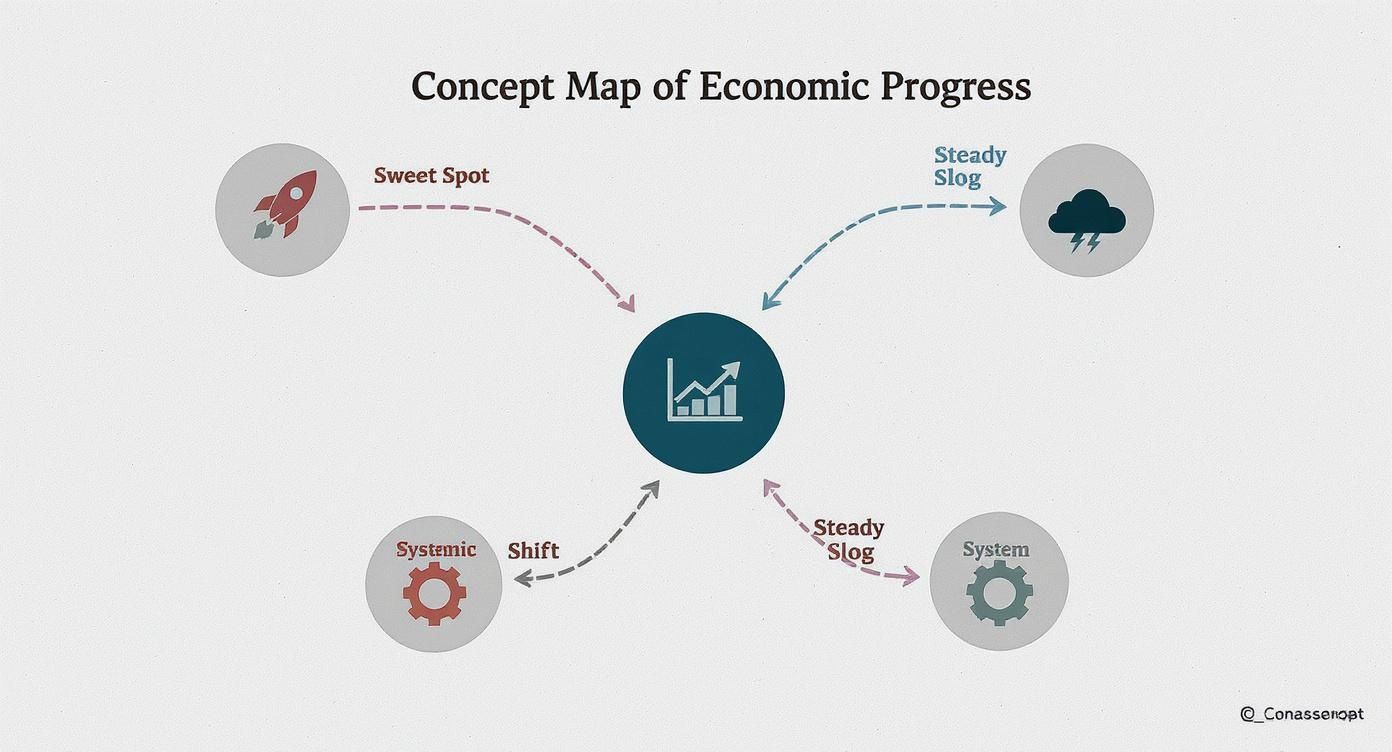
As you can see, the slog is just one possible state, standing in sharp contrast to periods of rapid growth (the "Sweet Spot") or disruptive change (a "Systemic Shift").
Core Distinctions and Audiences
Who uses each "slog" is probably the clearest way to tell them apart. Database Slog is a niche topic for systems architects and the engineers who build massive, globe-spanning applications. For them, it's all about performance, latency, and keeping data consistent.
On the other hand, Go's slog package is a practical tool for a much wider audience of software developers. Any programmer using the Go language can grab it and immediately start writing cleaner, structured logs. It's a direct improvement to their daily workflow for debugging and monitoring.
The economic slog, however, isn't a technical tool at all. It's a metaphor used by economists, policymakers, and journalists to describe broad societal and financial trends. It’s a way of talking about the economy, not a system you can actually build or implement.
Slog Showdown A Side-by-Side Comparison
To really lock in the differences, let's break down what each slog is in its own context. This table puts their core characteristics right next to each other, making the distinctions crystal clear.
| Aspect | Database Slog | Go Programming slog | Economic Slog |
|---|---|---|---|
| Primary Field | Distributed Systems | Software Development | Economics & Social Theory |
| Core Goal | Achieve low latency and strict consistency for global transactions. | Provide structured, machine-readable application logs. | Describe a period of slow but steady progress. |
| Key Principle | Exploiting data locality to minimize cross-region communication. | Using key-value pairs to organize log data for easy analysis. | Resilience and persistent effort against difficult conditions. |
| Intended User | Database Architects & Engineers | Go Language Developers | Economists & Analysts |
This comparison drives home the point that while they share a name, each "slog" is its own concept, built for a unique purpose.
The big takeaway here is context. The term 'slog' is defined entirely by the field you find it in. Knowing whether you’re talking about database performance, code observability, or economic analysis is the key to unlocking its real meaning.
Common Questions About Slog
After diving into the three very different worlds of "slog," a few questions always pop up. Let's clear up any confusion and nail down the differences between these concepts that just happen to share a name.
Which "Slog" Is the Most Common?
This really depends on who you're talking to. There isn't one universal meaning that trumps the others; each one is a big deal in its own professional circle.
- In the world of large-scale distributed systems and database research, Slog (usually with a capital 'S') is a well-known name for a high-performance system.
- For Go developers,
slogbecame a household name overnight when it was added to the standard library in Go 1.21. It's now a go-to tool for logging. - In economics and journalism, the metaphorical 'slog' is common language used to describe a long, tough stretch of economic conditions.
Are These Different "Slog" Concepts Related?
Not at all. The Slog database system and the slog Go package are completely separate technologies. They were built by different people, for entirely different reasons, and their shared name is just a coincidence.
The economic 'slog' is just the original English word, meaning a period of hard, persistent work, used in a metaphorical sense.
The key thing to remember is that the database system, the Go package, and the economic metaphor grew up in total isolation from one another. Their identical names are purely a linguistic accident.
How Can I Start Using the Go slog Package?
If you're running Go version 1.21 or newer, you're already set. The slog package is built right into the standard library, so there’s nothing extra to install.
You can jump right in by importing the log/slog package into your Go files. Getting started is as simple as calling functions like slog.Info() or slog.Error() for basic logging.
When you're ready for more control, like formatting your output as JSON, you can create a new logger with a custom handler. The official Go documentation is fantastic, with plenty of examples on how to create structured logs, set different log levels, and customize everything to your liking.
Ready to transform your photos and videos with stunning, professional-grade edits? Explore the premium Lightroom presets and LUTs from Preset Curator and find your perfect style today. Discover the collection at https://presetcurator.com.